
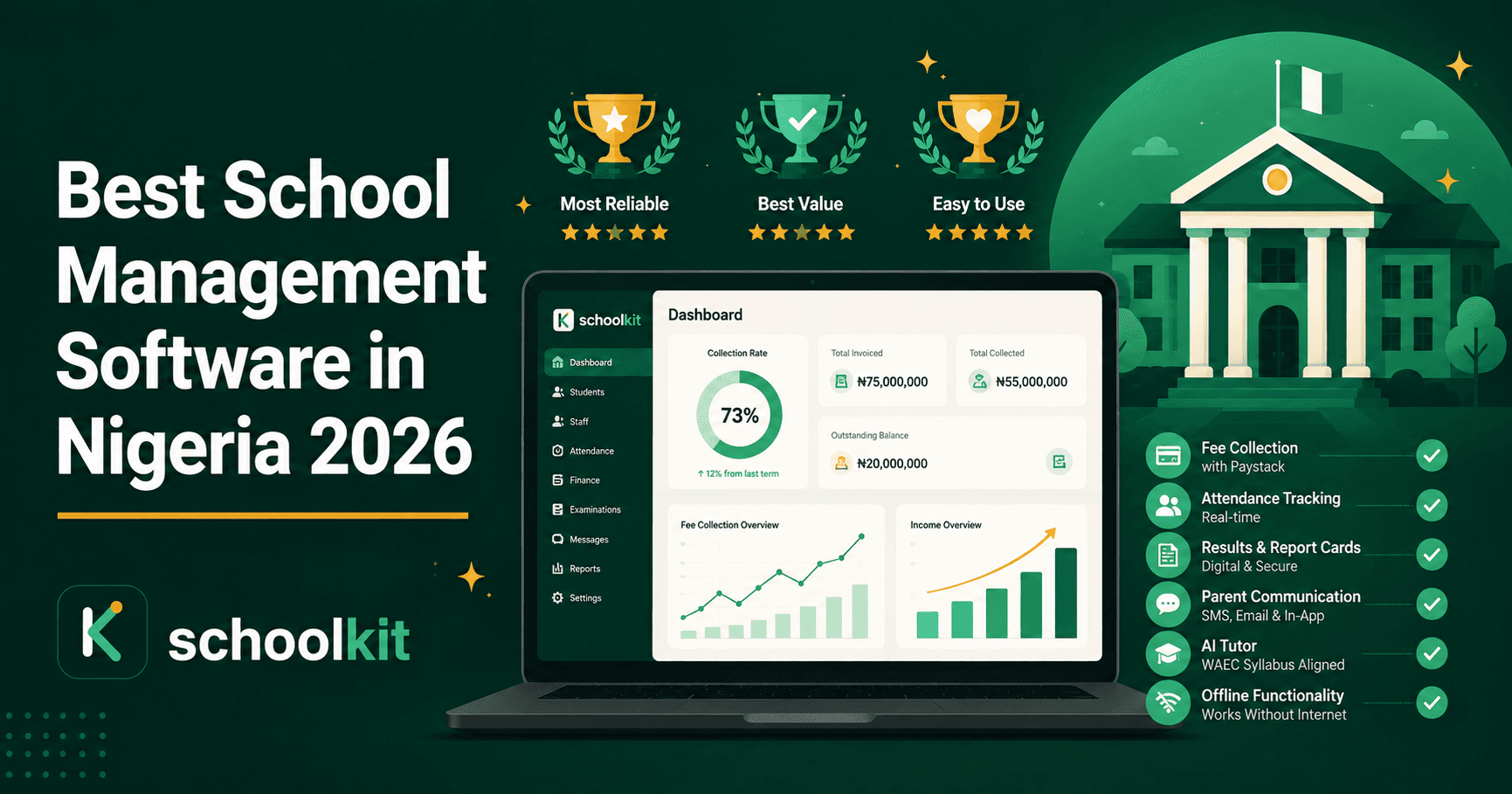
Search "school management software Nigeria" and you'll get a long list of options — some built specifically for the Nigerian market, others global products with a Nigeria page bolted on. Picking the wrong one is expensive: it means months of low adoption, a bursar who quietly goes back to Excel, and a switching cost you'll pay again in a year. Here's what actually matters when you're choosing.
What to look for
Strip away the marketing pages and most Nigerian schools are evaluating software against the same short list of real requirements:
- Does it actually collect fees, or just track them? Some tools generate an invoice and stop there — you still chase and confirm payment manually. Others integrate directly with a Nigerian payment processor and close the loop. Compare the complete school fees management workflow, including part payments, reconciliation, receipts and reporting.
- Does it work when the internet doesn't? Power and connectivity are not guaranteed in most parts of Nigeria. Software that requires a constant connection will fail exactly when your admin team needs it most.
- Does it speak WhatsApp and SMS, not just email? Nigerian parents are far more likely to see a WhatsApp message than check an email inbox for a school portal notification.
- Is grading aligned with WAEC/NECO conventions? A report card system built around a foreign curriculum structure means extra manual work to adapt it every term. Compare how school result management software handles CA, exams, grading, broadsheets and report cards.
- What does it actually cost per student, per term? Pricing that looks cheap per license can get expensive fast once you count every add-on module a Nigerian school actually needs. Use the 2026 school software pricing guide to compare the full cost, not just the headline figure.
How the options generally compare
Most school management software available to Nigerian schools falls into one of three categories:
Global platforms adapted for Nigeria. Often feature-rich, built originally for schools in the US, UK, or India, with Nigeria support added afterward. Payments usually route through processors that aren't native to Nigeria, which reintroduces the manual verification problem. Pricing is often in dollars, which adds currency risk for schools budgeting in naira.
Basic, free record-keeping tools. Fine for digitizing a student list, but light on fee collection and parent communication — the two areas that actually eat a school's admin time.
Software built from the ground up for Nigerian schools. A smaller set of options, but the ones in this category start from local realities: Paystack-native payments, WhatsApp-based communication, offline functionality, and WAEC/NECO-aligned grading — rather than retrofitting these as an afterthought.
Why "built for Nigeria" isn't just marketing language
The difference shows up in the details that matter day to day. A platform designed around Nigerian payment rails doesn't need parents to have a foreign-currency card. A platform designed with unreliable power in mind doesn't lose your attendance data the moment NEPA takes light — it queues the update and syncs automatically once you're back online. A platform designed for WAEC grading doesn't need your teachers to reinterpret an unfamiliar grading scale every report card season. None of this is visible in a feature-list comparison table; it only shows up once a school is actually using the software during a normal Nigerian school week.
Where SchoolKit fits
SchoolKit was built specifically for this: fee collection via Paystack, attendance tracking, automatic report card generation, staff management, and parent communication over WhatsApp and email — with full offline support so admin work doesn't stop when the network does. Pricing starts free for schools with up to 100 students, with paid plans from ₦45,000 per term for up to 200 students.
If you're comparing options, see how SchoolKit's plans and features work, or join the early-access waitlist to lock in founder pricing before general availability.
Switching school management software mid-year? Talk to us — pioneer schools get hands-on onboarding support, not just a login link.